
Role of AI in Creative Processes: Transforming Digital Ads

Struggling to keep pace with ever-changing demands in digital advertising? Small business owners and digital marketers everywhere face the challenge of delivering fresh, effective ads fast—without needing a team of experts. AI-powered creativity solves this by acting as a collaborative partner, amplifying human talent and accelerating creative workflows. Discover what AI-powered creativity really means, how it transforms your workflows, and what practical benefits it unlocks for your advertising efforts.
Table of Contents
- AI-Powered Creativity: Definition and Key Concepts
- Types of AI in Advertising Innovation
- How AI Shapes the Creative Workflow
- Risks, Bias, and Ethical Considerations
- Benefits for Marketers and Small Businesses
Key Takeaways
| Point | Details |
|---|---|
| AI as a Creative Partner | AI enhances your creative process by generating variations and analyzing performance while you maintain strategic control. |
| Speed and Efficiency | Utilizing AI significantly reduces the turnaround time for ad variations, allowing for quicker insights and optimized campaigns. |
| Data-Driven Decisions | AI empowers marketers to make informed decisions based on real-time data, optimizing ad performance and reducing costs. |
| Competitive Advantage | Small businesses can leverage AI tools to compete effectively against larger agencies, maximizing output without the need for a full creative team. |
AI-Powered Creativity: Definition and Key Concepts
AI-powered creativity isn't about machines replacing your ideas—it's about amplifying them. Think of AI as a creative partner that handles the heavy lifting while you steer the vision.
When we talk about AI in creative work, we're really describing a collaborative process. Your brand has a story to tell, and AI helps you tell it faster, smarter, and more effectively.
What AI-Powered Creativity Actually Means
AI-powered creativity refers to using artificial intelligence to enhance, accelerate, and refine your creative output. Instead of spending hours sketching concepts or testing variations, AI analyzes what works and generates options aligned with your brand voice.
For digital marketers and small business owners, this changes everything. You can create multiple ad variations in minutes instead of days, test different messaging instantly, and identify winning combinations before spending serious ad budget.
The key insight here: AI serves as a collaborative partner in creative work rather than a replacement. Your judgment determines direction; AI accelerates execution.
The Core Mechanics Behind AI Creativity
AI-powered creative tools work by processing three critical inputs:
- Your brand identity: Logo, color palette, tone, messaging style, visual preferences
- Proven winning elements: High-performing ads, audience engagement data, competitor insights
- Current trends: What's resonating now in your industry, seasonal opportunities, emerging formats
The system synthesizes these inputs to generate new ad variations that feel authentically yours while capitalizing on what actually converts.
This is different from generic design tools. Palmador.ai specifically learns your brand's DNA and trend patterns, then creates ads that align with both without requiring you to be a designer or data scientist.
Human-AI Partnership in Ad Creation
Here's what makes this work: human-AI co-creativity lets you leverage AI's processing power while keeping your strategic control.
You stay in charge. You:
- Set the campaign brief and brand guidelines
- Approve or reject AI-generated variations
- Make final decisions on which ads go live
- Interpret results and adjust strategy
AI handles the grunt work: generating variations, testing combinations, analyzing performance data, and suggesting optimizations based on patterns humans might miss.
Why This Matters for Your Bottom Line
Speed directly impacts ROI. Creating 10 ad variations manually takes a week. With AI, it takes an hour. Testing those variations across platforms used to mean waiting days for meaningful data. Now you get actionable insights in your first 24 hours.
This compression of time-to-insight means you spend less on underperforming ads and more on winners. Your budget stays lean while your creative velocity explodes.
The competitive advantage goes to marketers who can test, learn, and iterate faster than their competitors—AI makes that possible without overwhelming your team.
Small businesses particularly benefit. Without AI, you'd need a full creative team to match the output of mid-size agencies. With it, you punch above your weight.
Pro tip: Start by uploading your best-performing past ads to Palmador.ai—the platform learns your brand's winning patterns and builds from there, ensuring every generated variation feels authentically yours while testing new ideas.
Types of AI in Advertising Innovation
Not all AI works the same way in advertising. Different AI technologies handle different problems, and understanding which tool does what helps you pick the right solution for your needs.
When you're building ads with Palmador.ai, you're actually leveraging multiple AI types working together behind the scenes. Each one handles a specific part of the creative and optimization puzzle.
Generative AI: Creating From Scratch
Generative AI is the creative engine. It takes your inputs—brand guidelines, campaign brief, competitor data—and generates entirely new ad variations from scratch.
This is what creates your headlines, body copy, and visual concepts. Generative AI creates unique text, images, or video based on prompts you provide, scaling your content production exponentially.
For small business owners, this means you're no longer limited by how many concepts your team can manually brainstorm. The AI generates dozens of variations in minutes, each aligned with your brand voice.
Predictive Analytics: Forecasting What Works
Predictive analytics looks at historical data and tells you what's likely to happen next. It analyzes past ad performance, audience behavior patterns, and seasonal trends to forecast which variations will perform best before you even launch them.
Instead of guessing which ad copy resonates, predictive analytics shows you the probability of success based on real data. This reduces wasted spend on underperforming concepts.
You're essentially getting a crystal ball powered by your own performance history.
Automated Bidding: Spending Smarter
Automated bidding removes the manual work from ad placement optimization. AI continuously adjusts your bids across platforms to maximize conversions while staying within your budget.
Here's what it does:
- Analyzes real-time performance across channels
- Adjusts bids millisecond by millisecond
- Allocates more budget to high-performing placements automatically
- Reduces spend on low-converting audiences
You set your target cost-per-acquisition or return-on-ad-spend goal, and the AI handles the rest.
Personalization and Content Optimization
Large language models and AI systems dynamically optimize creative content in ads, improving relevance and targeting precision. This means each audience segment sees messaging tailored specifically to them.

The same campaign can show different headlines, images, or calls-to-action to different user groups based on their likely preferences. A budget-conscious audience sees different messaging than a premium-focused one.
Chatbots and Conversational AI
Conversational AI handles customer interaction after they click your ad. Chatbots answer questions, qualify leads, and guide prospects toward purchase without waiting for a human to respond.
This extends your creative work beyond the ad itself into the entire customer journey.
The real power isn't any single AI type—it's how they work together to handle creative generation, prediction, optimization, and personalization simultaneously, turning your limited resources into a full-scale marketing operation.
Palmador.ai integrates these AI types into one workflow, so you benefit from all of them without managing each separately.
Here's a summary of the main types of AI used in advertising and their unique contributions:
| AI Type | Main Purpose | Key Benefit | Typical Business Impact |
|---|---|---|---|
| Generative AI | Creates ad content | Rapid variation generation | Multiply creative output |
| Predictive Analytics | Forecasts performance | Higher accuracy decisions | Reduces wasted ad budget |
| Automated Bidding | Optimizes ad placement | Smarter fund allocation | Increases ROI and lowers costs |
| Personalization AI | Tailors content | More relevant messaging | Boosts conversion rates |
| Conversational AI | Manages interactions | Faster customer response | Improves lead qualification |
Pro tip: Start with generative AI to create multiple ad variations, then let predictive analytics rank them by likely performance before spending budget—this two-step approach dramatically improves your ROI without requiring you to guess which concepts work.
How AI Shapes the Creative Workflow
Your creative process just changed. Instead of starting from blank canvas and grinding through iterations, AI reshapes how you ideate, produce, and refine ads from start to finish.
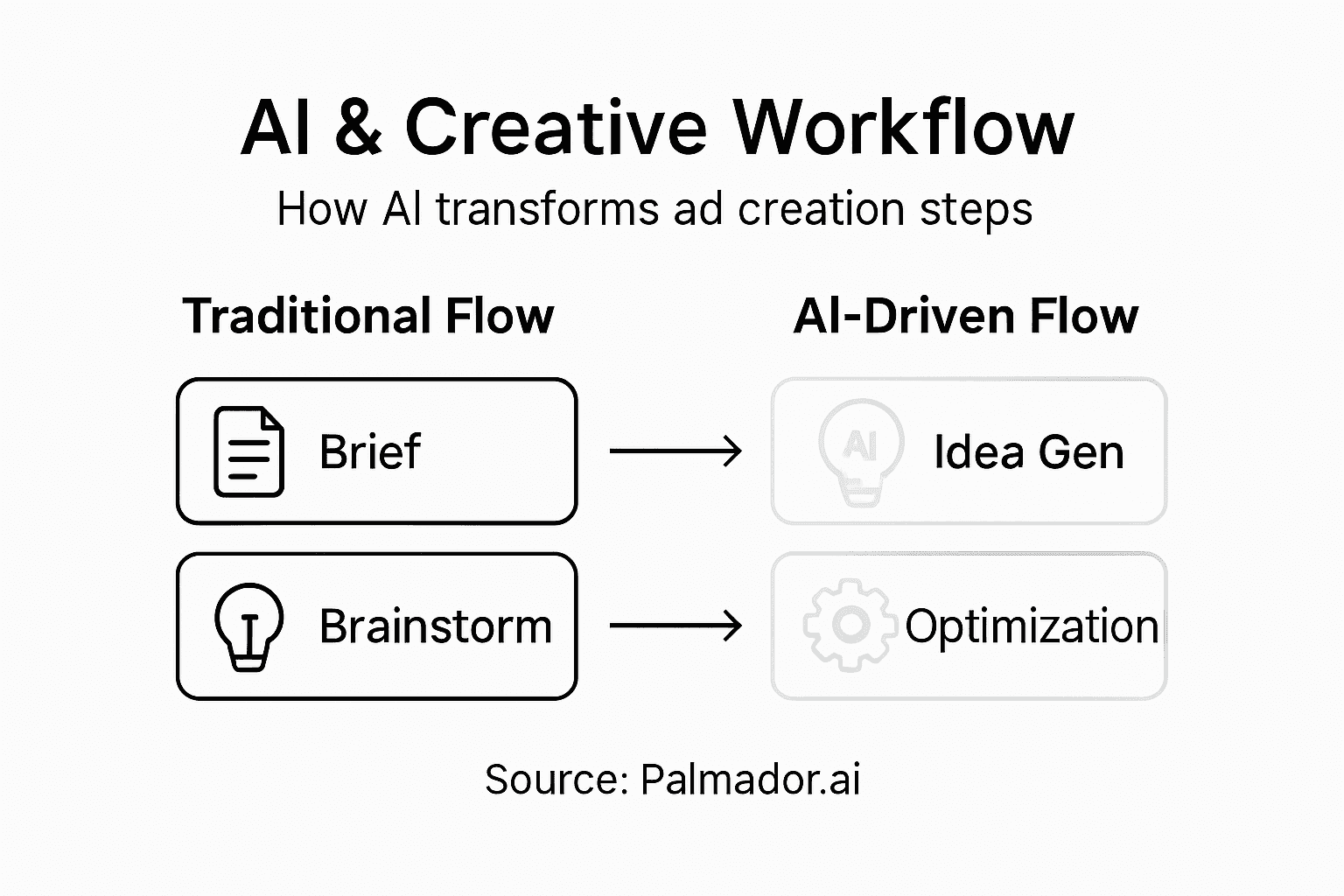
The workflow becomes faster, more flexible, and surprisingly more creative. You're not replacing your judgment—you're amplifying it.
The Traditional Bottleneck
Traditional ad creation follows a painful sequence: brief, brainstorm, design, feedback, revisions, more revisions, final approval. Each round takes days or weeks. By the time you launch, market conditions have shifted.
Small business owners especially feel this pain. You can't hire a full creative team, so one person juggles everything. Velocity suffers. Opportunities slip away.
Breaking Through Creative Blocks
AI breaks creative blocks by allowing rapid content generation and exploration of new styles and formats. When you're stuck on messaging or visual direction, the AI generates dozens of alternatives instantly.
You're no longer waiting for inspiration. The AI suggests directions you might not have considered, which sparks ideas you actually implement.
This iterative speed changes everything about your creative capacity.
The Human-AI Collaboration Model
Here's how the workflow actually works:
- You provide direction: Campaign brief, brand guidelines, target audience, performance goals
- AI generates options: Creates multiple ad variations, headlines, visuals, and copy angles
- You evaluate and refine: Select promising directions, provide feedback, ask for adjustments
- AI iterates: Regenerates variations based on your feedback in seconds
- You finalize and launch: Make final strategic decisions about which ads go live
You're making the critical decisions. The AI handles the production burden.
What Changes in Your Day-to-Day
AI serves as a collaborative partner that enhances creative capacity by generating ideas, offering alternatives, and processing large datasets while humans provide judgment and aesthetic sensibility.
Your role shifts from executer to strategist. Instead of spending four hours designing one ad concept, you spend 20 minutes reviewing ten AI-generated concepts and selecting the strongest directions.
The time you save goes toward strategy, testing, and optimization.
The table below compares key differences between traditional creative workflows and AI-powered creative processes:
| Aspect | Traditional Workflow | AI-Powered Workflow |
|---|---|---|
| Turnaround Time | Days to weeks | Minutes to hours |
| Required Team Size | Multiple specialists | Single operator possible |
| Number of Variations | Few per week | Dozens in one session |
| Use of Data | Limited manual review | Automated pattern analysis |
| Strategic Focus | On production tasks | On decision making |
Speed Compounds Your Advantage
Here's the compounding effect: faster iteration means more test data. More test data means better predictions. Better predictions mean higher ROI. Higher ROI means bigger budgets to test further.
Competitors stuck in traditional workflows can't keep pace.
The real shift isn't about AI doing your job—it's about AI handling the repetitive production work so you can focus on strategy, judgment, and the decisions that actually move your business forward.
Palmador.ai automates this entire workflow, turning your ad creation from a week-long bottleneck into a same-day process.
Pro tip: Set aside 30 minutes weekly to review your past month's ad performance with Palmador—use that data to brief the AI on what's actually working, and it'll generate next-month's variations based on proven winners rather than starting from scratch.
Risks, Bias, and Ethical Considerations
AI isn't a magic wand. It amplifies whatever patterns exist in your data, including the bad ones. Understanding these risks protects your brand reputation and keeps your campaigns compliant.
The good news: awareness and deliberate practices prevent most problems. You're not powerless here.
The Bias Problem
Algorithmic bias occurs when AI trains on incomplete or biased datasets, resulting in unfair targeting or problematic ad content. If your training data overrepresents one demographic, the AI learns to favor that group and exclude others.
Example: If your historical ad data shows poor performance with older audiences, the AI might deprioritize showing ads to them—even if you've changed your product offering.
Bias isn't always obvious. It hides in the data patterns you don't notice.
Data Privacy and Consumer Manipulation
AI in advertising raises ethical issues including data privacy and algorithmic bias, creating risks of unfair targeting and consumer manipulation. Collecting massive amounts of user data to train and optimize AI models creates privacy exposure.
You need clear consent policies and transparent data practices. Users should know how their information influences the ads they see.
Transparency builds trust. Opacity destroys it.
Copyright and Content Ownership
Deepfakes, copyright infringement, and artist displacement represent emerging risks in AI creative work. If your AI trains on copyrighted images without permission, you're potentially liable.
When using Palmador.ai or similar tools, verify that:
- Training data respects copyright protections
- You own rights to generated content
- Your use complies with platform terms
- Original creator rights are acknowledged where applicable
Misinformation and Misleading Claims
AI can generate persuasive content—sometimes too persuasive. Ads that make exaggerated claims or mislead consumers violate FTC regulations and damage brand credibility.
You remain legally responsible for what your ads claim, regardless of who (or what) created them. Review AI-generated copy carefully before launch.
The fundamental rule: you own every ad that runs under your brand, which means you're accountable for its accuracy, fairness, and compliance. AI is the tool; your judgment is the safeguard.
Practical Risk Mitigation
Reduce ethical exposure through deliberate practices:
- Audit training data: Verify it's representative and unbiased before building campaigns
- Review all output: Check AI-generated ads for accuracy and fairness before approval
- Document decisions: Keep records of how you selected and approved creative variations
- Test across segments: Ensure ads perform fairly across different demographic groups
- Disclose AI use: Be transparent when AI tools contribute to your creative process
Your Responsibility
AI is a tool that amplifies your decisions. If you feed it biased data, you get biased output. If you fail to review generated content, you get what you deserve legally.
The platform handles execution. You handle accountability.
Pro tip: Before launching any AI-generated campaign, run it past the question: "Would I feel comfortable defending this ad's claims in front of the FTC?" If hesitation appears, revise before spending budget.
Benefits for Marketers and Small Businesses
AI doesn't just speed up your work. It fundamentally changes what's possible for teams without massive budgets. This is where small businesses finally get to compete.
When resources are tight, leverage matters more than headcount. AI is leverage.
Automation of Repetitive Tasks
You spend hours on work that doesn't move the needle. Scheduling posts, resizing ads, updating spreadsheets, organizing assets. These tasks drain your focus without creating value.
AI automates tedious administrative and marketing tasks, reducing overhead, errors, and time spent on repetitive work. You reclaim hours every week to spend on strategy and customer relationships.
Suddenly, one person can manage what used to require three.
Hyper-Personalization at Scale
Large brands personalize campaigns because they have data teams. You probably don't. AI levels this playing field.
AI enables hyper-personalized customer experiences and data-driven decision-making, allowing marketers to segment audiences and customize messaging without manual effort.
Each customer sees ads tailored to their behavior and preferences. Personalization means higher relevance, better conversion rates, and happier customers.
Speed Creates Competitive Advantage
Traditional agencies need weeks to produce ad variations. You need them in hours. Speed becomes your unfair advantage.
With Palmador.ai, you can:
- Generate 10 ad variations in 30 minutes instead of two days
- Test new messaging instantly based on performance data
- Respond to market opportunities while competitors are still brainstorming
- Launch campaigns faster than anyone in your industry
Moving twice as fast as competitors compounds over months and years.
Cost-Effective Growth
AI tools cost less than hiring one full-time designer or copywriter. You get the output of a small team without the payroll burden.
For small businesses, this completely changes the equation. Your marketing costs shrink while output explodes. That margin difference gets reinvested into paid ads or product improvements.
Data-Driven Decision Making
You no longer guess which ads might work. AI analyzes performance patterns and shows you what actually resonates.
This transforms marketing from art into science. You know which headlines convert, which visuals drive clicks, which audience segments spend money. Every decision is backed by data.
The real advantage isn't the tool itself—it's the speed and data access that let you learn faster, iterate smarter, and spend less to achieve more than competitors still using manual processes.
Competitive Edge You Can Measure
Marketers who master AI technologies gain measurable advantages: higher campaign efficiency, faster content creation, accurate targeting, and improved ROI.
Your competitors aren't there yet. That window doesn't stay open forever.
Pro tip: Benchmark your current ad performance metrics this week—cost per click, conversion rate, return on ad spend—then implement AI-generated variations for 30 days and measure the difference. That data proves ROI to yourself and justifies further investment.
Unlock Next-Level Creative Power with Palmador.ai
The article highlights the challenge of producing impactful digital ads quickly while maintaining your brand's unique voice and leveraging data-driven insights. If you are struggling with slow turnaround times, limited creative resources, or want to avoid costly trial and error in ad creation, Palmador.ai offers the perfect solution. By integrating concepts like generative AI, predictive analytics, and trend analysis, Palmador.ai enables you to accelerate your creative workflow and consistently generate ads that resonate with your audience.

Experience how Palmador.ai transforms digital advertising by automating ad generation based on your brand's identity and proven winning strategies. Start creating multiple, high-performing ad variations in minutes instead of days and optimize your marketing spend like never before. Take the next step to elevate your digital marketing results today by visiting Palmador.ai. Discover a smarter way to work through the AI-powered creativity platform, and see how you can maximize your advertising ROI while saving time on creative production.
Frequently Asked Questions
What is AI-powered creativity in digital advertising?
AI-powered creativity refers to the use of artificial intelligence to enhance and refine the creative process in digital advertising. It acts as a collaborative partner that helps generate ideas, produce variations, and optimize campaigns more efficiently than traditional methods.
How can AI accelerate the ad creation process?
AI can significantly speed up the ad creation process by quickly generating multiple ad variations based on brand guidelines and proven elements, allowing marketers to launch campaigns faster and test different messaging with minimal delay.
What types of AI technologies are used in advertising?
Common AI technologies used in advertising include generative AI for creating ad content, predictive analytics for forecasting performance, automated bidding for optimizing ad spend, and personalization AI for tailoring messages to specific audience segments.
How does AI improve the effectiveness of marketing campaigns?
AI improves campaign effectiveness by providing data-driven insights, allowing for hyper-personalized experiences, and optimizing ad placements in real-time. This leads to increased conversion rates, reduced wasted ad spend, and a higher return on investment.