
Visual Content Marketing: Driving Brand Engagement

Creating standout video content often feels challenging for Social Media Managers and Content Marketers at global brands, especially when technical skills are limited. Staying competitive means quickly capturing attention and building genuine audience connections. Visual content marketing now acts as a main driver for brand storytelling, audience engagement, and conversion, making it essential for brands who want to grow their online presence with efficient tools and strategies.
Table of Contents
- What Visual Content Marketing Means Today
- Major Visual Content Types and Platforms
- How AI Is Shaping Video Creation
- Strategic Benefits for Social Media Marketers
- Pitfalls, Misconceptions, and Key Success Factors
Key Takeaways
| Point | Details |
|---|---|
| Visual Content is Essential | Brands must leverage visual content as a primary communication tool to effectively engage audiences and convey complex messages. |
| Quality Over Quantity | Prioritize creating original, high-quality visuals tailored to specific audience segments rather than relying on generic stock materials. |
| AI Enhances Creativity | Utilize AI technologies to streamline video creation processes while blending algorithmic efficiency with human creativity. |
| Understand Platform Nuances | Adapt visual content strategies to align with the unique preferences and algorithms of different social media platforms for maximum engagement. |
What Visual Content Marketing Means Today
Visual content marketing has transformed from a simple design strategy into a powerful communication mechanism that drives digital engagement. Media research reveals that modern visual content serves far more than aesthetic purposes - it's now a critical tool for brand storytelling, consumer attraction, and conversion optimization.
In today's digital ecosystem, visual content represents a sophisticated blend of design, psychology, and strategic communication. Digital Marketing Visuals are no longer just supplementary elements but primary communication channels that convey complex narratives quickly and emotionally. Creative research demonstrates that modern visual content encompasses multiple formats including:
- Photographs and branded imagery
- Short-form and long-form video content
- Interactive infographics
- Live streaming presentations
- Animation and motion graphics
- User-generated visual content
The strategic importance of visual content marketing extends beyond mere aesthetic appeal. These visual assets function as powerful communication tools that help brands:
- Simplify complex information
- Evoke emotional connections
- Increase audience retention
- Improve message comprehension
- Support search engine optimization efforts
- Drive higher engagement rates
Visual content marketing transforms passive viewers into active participants in brand narratives.
The contemporary visual marketing landscape demands more than generic stock images or templated designs. Successful brands now focus on creating authentic, meaningful visual experiences that resonate with specific audience segments. This requires deep understanding of visual psychology, design principles, and audience preferences.
Pro tip: Invest in creating original, high-quality visual content that tells a unique story about your brand, rather than relying on generic stock materials.
Major Visual Content Types and Platforms
Backlinko research highlights the diverse landscape of visual content marketing, revealing a rich ecosystem of formats designed to capture audience attention and drive engagement. Modern digital strategies leverage multiple visual content types, each serving unique communication objectives and platform preferences.
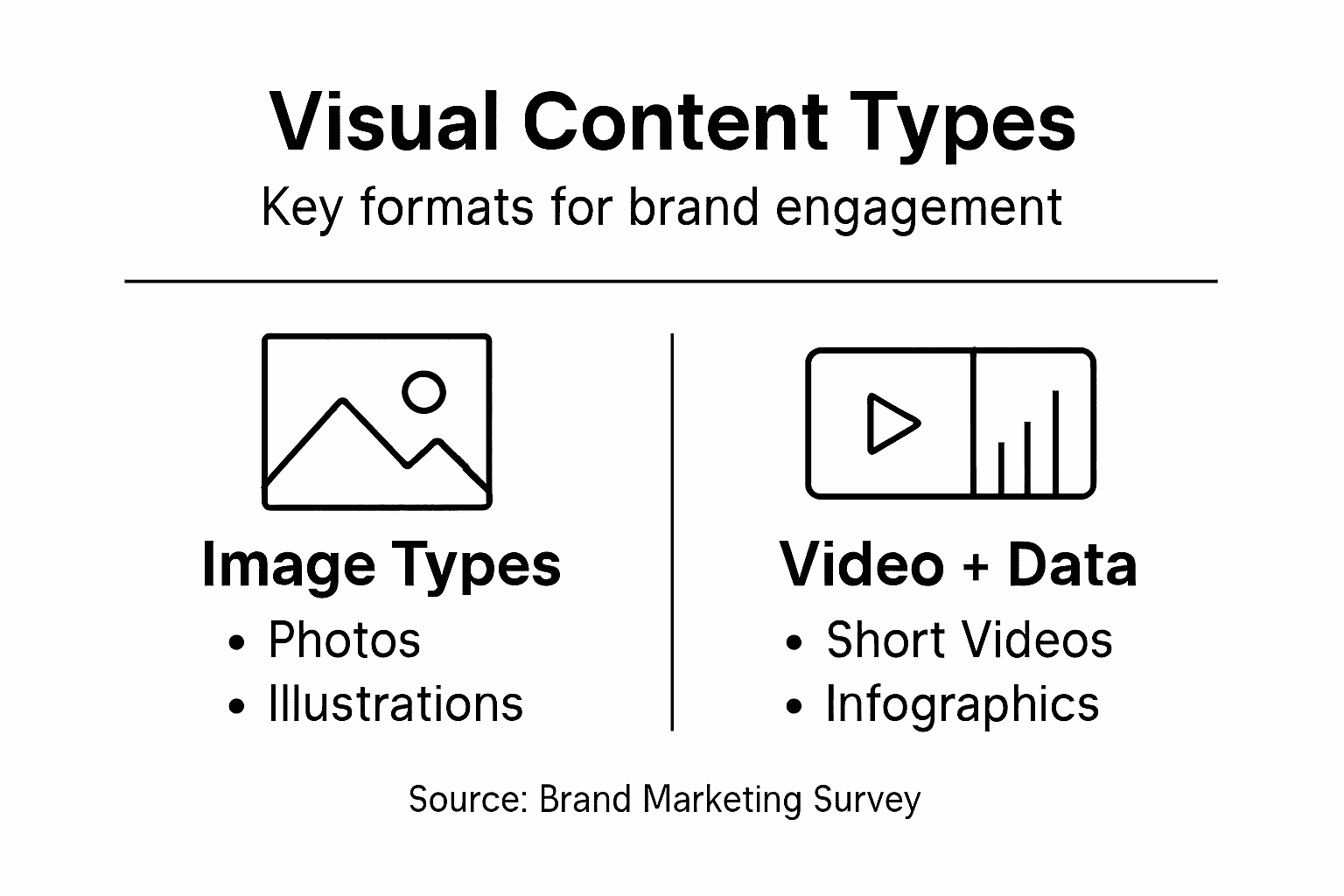
Visual Content Categories encompass a wide range of creative formats, with key types including:
- Images: Static branded visuals and photography
- Infographics: Data-driven visual explanations
- Native Videos: Platform-specific video content
- Concept Visuals: Abstract and illustrative graphics
- Animated Content: GIFs, motion graphics, and short animations
- User-Generated Visuals: Customer-created brand content
Platform-specific research demonstrates that different social media channels optimize unique visual approaches. Social platforms like Instagram and Facebook prioritize immersive, quick-consuming visual formats that keep users engaged and scrolling.
The strategic selection of visual content types depends on multiple factors:
- Target audience demographics
- Marketing campaign objectives
- Platform algorithmic preferences
- Brand storytelling requirements
- Content consumption habits
- Engagement potential
Visual content is no longer optional - it's a fundamental communication strategy for modern brands.
Successful visual marketing requires understanding each format's strengths and matching them with specific communication goals. Brands must move beyond generic content and create purposeful, platform-optimized visual experiences that resonate with their specific audience segments.
Pro tip: Develop a diverse visual content library that can be strategically adapted across multiple platforms and marketing objectives.
Here's a quick comparison of major visual content types and their most effective platforms:
| Content Type | Best Platform | Distinct Strength |
|---|---|---|
| Short-form Video | Instagram, TikTok | Instant audience reach |
| Infographics | LinkedIn, Pinterest | Visual data clarity |
| User-Generated Visuals | Facebook, Twitter | Authentic engagement |
| Animations | YouTube, Websites | Explaining concepts |
| Branded Photography | Instagram, Facebook | Brand identity boost |
How AI Is Shaping Video Creation
Scientific research reveals that generative AI is fundamentally transforming video content creation, enabling marketers to produce sophisticated marketing materials with unprecedented speed and precision. This technological revolution is redefining how brands conceptualize, develop, and distribute visual content across digital platforms.
AI Video Creation Technologies are reshaping marketing strategies through advanced capabilities such as:
- Automated script generation
- Intelligent scene composition
- Dynamic content personalization
- Rapid editing and post-production
- Voice and language adaptation
- Real-time content optimization
Advanced AI platforms now analyze audience behavior to generate highly targeted video content. These intelligent systems can predict engagement patterns, recommend optimal messaging, and customize visual narratives for specific demographic segments.
The transformative potential of AI in video creation extends across multiple strategic dimensions:
- Reducing production costs
- Accelerating content development timelines
- Enabling hyper-personalized marketing experiences
- Maintaining consistent brand messaging
- Supporting global content localization
- Enhancing creative experimentation
AI is not replacing human creativity - it's amplifying and extending creative capabilities beyond traditional limitations.
Marketers and content creators must embrace these technological advancements while maintaining a critical perspective on AI's capabilities and limitations. The most successful strategies will blend algorithmic efficiency with human creativity and strategic insight.
Pro tip: Experiment with AI video tools strategically, treating them as collaborative technologies that enhance rather than replace human creative vision.
Use this table to understand how AI enhances each stage of video creation:
| Stage of Video Creation | AI-Powered Enhancement | Resulting Advantage |
|---|---|---|
| Research & Scripting | Automated script generation | Faster messaging alignment |
| Editing | Intelligent scene composition | Smoother workflows |
| Personalization | Dynamic content adaptation | Custom messages for audiences |
| Localization | Voice/language adaptation | Broader geographic reach |
| Performance Tracking | Real-time content optimization | Immediate campaign improvement |
Strategic Benefits for Social Media Marketers
Blog research highlights the transformative power of visual content in social media marketing, revealing how strategic visual storytelling can dramatically enhance brand engagement and audience connection. Modern social media marketers are increasingly recognizing visual content as a critical communication tool that goes far beyond mere aesthetic appeal.
Strategic Visual Marketing Benefits encompass multiple performance dimensions:
- Increased audience engagement rates
- Enhanced information retention
- Stronger emotional brand connections
- Higher social media interaction volumes
- More compelling storytelling capabilities
- Improved conversion potential
Scientific analysis demonstrates that visual content's effectiveness depends on three critical factors: volume, variety, and dynamism. Successful social media strategies integrate diverse visual formats that can quickly capture audience attention and provoke meaningful interactions.
The profound impact of visual content extends across key marketing objectives:
- Humanizing brand personalities
- Building audience trust
- Establishing long-term brand loyalty
- Simplifying complex messaging
- Creating memorable brand experiences
- Differentiating from competitive offerings
Visual storytelling transforms passive viewers into active brand participants.
Social media marketers must approach visual content as a sophisticated communication strategy, carefully balancing creativity, data insights, and audience understanding. The most successful brands will develop nuanced visual narratives that resonate authentically with their target demographics.

Pro tip: Develop a consistent visual language that reflects your brand's unique personality while remaining adaptable across different social media platforms.
Pitfalls, Misconceptions, and Key Success Factors
Academic research unveils critical insights into the complex landscape of visual content marketing, highlighting the nuanced challenges that can derail even well-intentioned strategies. Understanding these potential pitfalls is essential for developing robust and effective visual communication approaches.
Common Visual Content Misconceptions include:
- Believing more content guarantees better engagement
- Assuming visual quality trumps strategic relevance
- Thinking generic visuals work across all platforms
- Underestimating audience-specific preferences
- Neglecting mobile optimization requirements
- Lacking a coherent visual brand narrative
Marketing analysis indicates that successful visual strategies demand far more than superficial aesthetic considerations. The most effective approaches integrate deep audience understanding, precise targeting, and strategic content alignment.
Key potential pitfalls marketers must navigate include:
- Misaligning visual content with brand identity
- Overlooking platform-specific optimization
- Creating visuals without clear communication objectives
- Ignoring data-driven performance insights
- Failing to maintain consistent visual messaging
- Underestimating production quality requirements
Visual content success requires strategic intelligence, not just creative impulse.
Successful visual content marketers recognize that effectiveness emerges from a sophisticated blend of creativity, data analysis, and audience empathy. Continuous learning, experimentation, and performance tracking are critical for developing compelling visual communication strategies.
Pro tip: Regularly audit your visual content performance using platform-specific analytics to refine and optimize your strategic approach.
Elevate Your Visual Content Marketing with AI-Powered Video Creation
Visual content marketing is no longer just about pretty images but about crafting authentic, emotionally resonant stories that engage and convert your audience. The challenge many marketers face is producing high-quality, original video content quickly while maintaining consistent brand messaging and strategic relevance. Terms like automated script generation, dynamic content personalization, and intelligent scene composition highlight how complex video creation has become — and how vital it is to have streamlined solutions that blend creativity with technology.
Palmedor.ai answers this critical need by offering a powerful AI-powered platform that turns simple prompts and images into professional-grade videos tailored for every marketing goal. Whether you want to simplify message complexity, build emotional connections, or create hyper-personalized social media clips, Palmedor.ai helps you achieve more with less effort. With smart presets, scene management, and output customization, your brand can break through the noise with cinematic visual stories that truly resonate.
Ready to transform your visual marketing strategy today?

Experience how AI can amplify your creative vision and streamline your production workflow at Palmedor.ai. Discover tools designed specifically to help you develop brand films, social clips, or narrative videos easily. Start creating captivating visual content now that drives engagement and converts audiences. Explore more and get started with your first video on the Palmedor.ai homepage.
Frequently Asked Questions
What is visual content marketing?
Visual content marketing is the use of visual elements like images, videos, infographics, and animations to communicate messages, attract consumers, and drive engagement. It serves as a powerful storytelling tool for brands to connect with their audience quickly and emotionally.
How can visual content improve brand engagement?
Visual content enhances brand engagement by simplifying complex information, evoking emotional connections, and increasing retention rates. It transforms passive viewers into active participants in brand narratives, ultimately improving interactions and conversions.
What are the main types of visual content used in marketing?
Main types of visual content include photographs, videos (both short-form and long-form), infographics, animations, interactive graphics, and user-generated content. Each type serves different communication objectives and works best on specific platforms.
How does AI influence video content creation?
AI influences video content creation by providing automated features like script generation, scene composition, and dynamic content personalization. These technologies allow marketers to produce high-quality videos quickly and tailor them to specific audience segments, enhancing engagement and efficiency.