
Why Use AI for Marketing: Smarter ROI in 2026

Facing endless campaign tweaks and soaring costs, digital marketing managers often wonder how to achieve greater results with fewer resources. Artificial Intelligence is now a powerful ally, automating ad targeting and creative generation while offering smarter insights that once seemed out of reach. This article explains how AI-driven marketing transformation delivers better targeting, personalization, and real-time optimization, making high-performance advertising accessible without complex technical skills.
Table of Contents
- Defining AI in Modern Marketing
- Key AI Applications for Digital Ads
- How AI Personalizes Customer Journeys
- Cost, Efficiency, and ROI Advantages
- Risks, Challenges, and Best Practices
Key Takeaways
| Point | Details |
|---|---|
| Transformative Role of AI | AI is revolutionizing marketing by enhancing data analysis and personalization to predict customer behavior effectively. |
| Performance Improvements | Businesses using AI-driven strategies can expect significant increases in conversion rates and reduced marketing waste. |
| Ethical Considerations | Integrating AI in marketing requires addressing algorithmic bias and ensuring data privacy to maintain consumer trust. |
| Incremental Implementation | Start small with AI tools that provide measurable outcomes, then gradually expand as successes are demonstrated. |
Defining AI in Modern Marketing
Artificial Intelligence (AI) is rapidly transforming digital marketing by revolutionizing how businesses understand, engage, and predict customer behaviors. Unlike traditional marketing approaches, AI enables unprecedented levels of data analysis and personalization, fundamentally reshaping marketing strategies across industries.
Modern marketing AI leverages advanced technologies to deliver sophisticated insights and automated solutions. Comprehensive marketing transformation now involves multiple critical capabilities:
- Predictive customer behavior modeling
- Hyper-personalized content generation
- Real-time audience segmentation
- Automated customer interaction management
- Intelligent advertising optimization
The strategic integration of AI goes far beyond simple automation. Machine learning algorithms can now process massive datasets, identifying nuanced patterns that human analysts might miss. These intelligent systems continuously learn and adapt, providing marketers with dynamic insights that evolve in real-time.
AI transforms marketing from a reactive discipline into a proactive, predictive science that anticipates customer needs before they emerge.
Businesses implementing AI-driven marketing strategies can expect significant performance improvements. Predictive analytics enable more precise targeting, reducing marketing waste and increasing conversion rates. By analyzing complex behavioral signals, AI helps companies create more resonant, personalized experiences that feel individually crafted.
Pro tip: Start small by integrating AI tools that offer clear, measurable outcomes and gradually expand your technological capabilities as you demonstrate initial successes.
Here's a summary of how AI enhances each stage of the marketing funnel:
| Funnel Stage | AI-Powered Enhancement | Business Outcome |
|---|---|---|
| Awareness | Real-time audience segmentation | Better reach for new prospects |
| Consideration | Hyper-personalized content delivery | Higher engagement rates |
| Conversion | Predictive behavior modeling | Increased sales and conversions |
| Retention | Intelligent recommendation engines | Improved customer loyalty |
| Advocacy | Automated personalized communication | Enhanced word-of-mouth influence |
Key AI Applications for Digital Ads
Artificial Intelligence is dramatically transforming digital advertising by introducing sophisticated capabilities that go far beyond traditional marketing strategies. Programmatic ad buying technologies now enable marketers to analyze massive datasets and optimize campaign performance with unprecedented precision.
Modern AI applications in digital advertising encompass several critical domains:
- Automated ad targeting and personalization
- Real-time bidding optimization
- Intelligent content generation
- Predictive audience segmentation
- Dynamic performance monitoring
- Creative asset optimization
Machine learning algorithms are particularly powerful in digital advertising, allowing for hyper-targeted campaigns that adapt instantaneously to changing user behaviors. These intelligent systems can process complex behavioral signals, generating insights that human analysts might overlook.
AI transforms digital advertising from a scattershot approach to a laser-focused, data-driven strategy that maximizes every advertising dollar.
The most advanced AI tools now integrate multiple sophisticated capabilities. Generative AI can create multiple ad variations, test different messaging approaches, and automatically select the most effective content based on real-time performance metrics. This means marketers can develop more nuanced, responsive advertising strategies that continuously improve without manual intervention.

Pro tip: Implement AI-driven advertising tools incrementally, starting with one specific function like audience targeting, and progressively expand your technological capabilities as you demonstrate measurable improvements.
The following table contrasts traditional and AI-driven digital advertising approaches:
| Advertising Approach | Traditional Method | AI-Driven Method |
|---|---|---|
| Targeting Precision | Broad demographic targeting | Real-time, behavioral targeting |
| Ad Optimization | Manual campaign adjustments | Automated dynamic optimization |
| Content Adaptation | Single creative per campaign | Multiple AI-generated versions |
| Performance Analysis | Delayed, periodic reporting | Continuous, real-time metrics |
How AI Personalizes Customer Journeys
Artificial Intelligence is revolutionizing the way businesses understand and engage with individual customers by creating deeply personalized experiences across every stage of the customer journey. AI-powered personalization technologies now enable companies to craft unique interactions that adapt in real-time to each customer's preferences and behaviors.
The most sophisticated AI personalization strategies involve multiple advanced capabilities:
- Predictive behavioral analysis
- Real-time content customization
- Dynamic pricing optimization
- Intelligent recommendation engines
- Personalized communication channels
- Contextual interaction mapping
Machine learning algorithms can now process complex behavioral signals with unprecedented precision, transforming raw data into actionable insights that create seamless, individualized customer experiences. These intelligent systems continuously learn and adapt, ensuring that each interaction becomes more refined and targeted.
Personalization is no longer a marketing luxury - it's a fundamental expectation in the age of intelligent technology.
Advanced AI tools are breaking traditional marketing boundaries by integrating multiple data sources to create holistic customer profiles. Natural language processing and predictive analytics allow businesses to anticipate customer needs before they even articulate them, delivering proactive and intuitive experiences that feel almost magical.
Pro tip: Start your AI personalization journey by focusing on one critical customer touchpoint, gathering comprehensive data, and progressively expanding your personalization capabilities as you demonstrate measurable engagement improvements.
Cost, Efficiency, and ROI Advantages
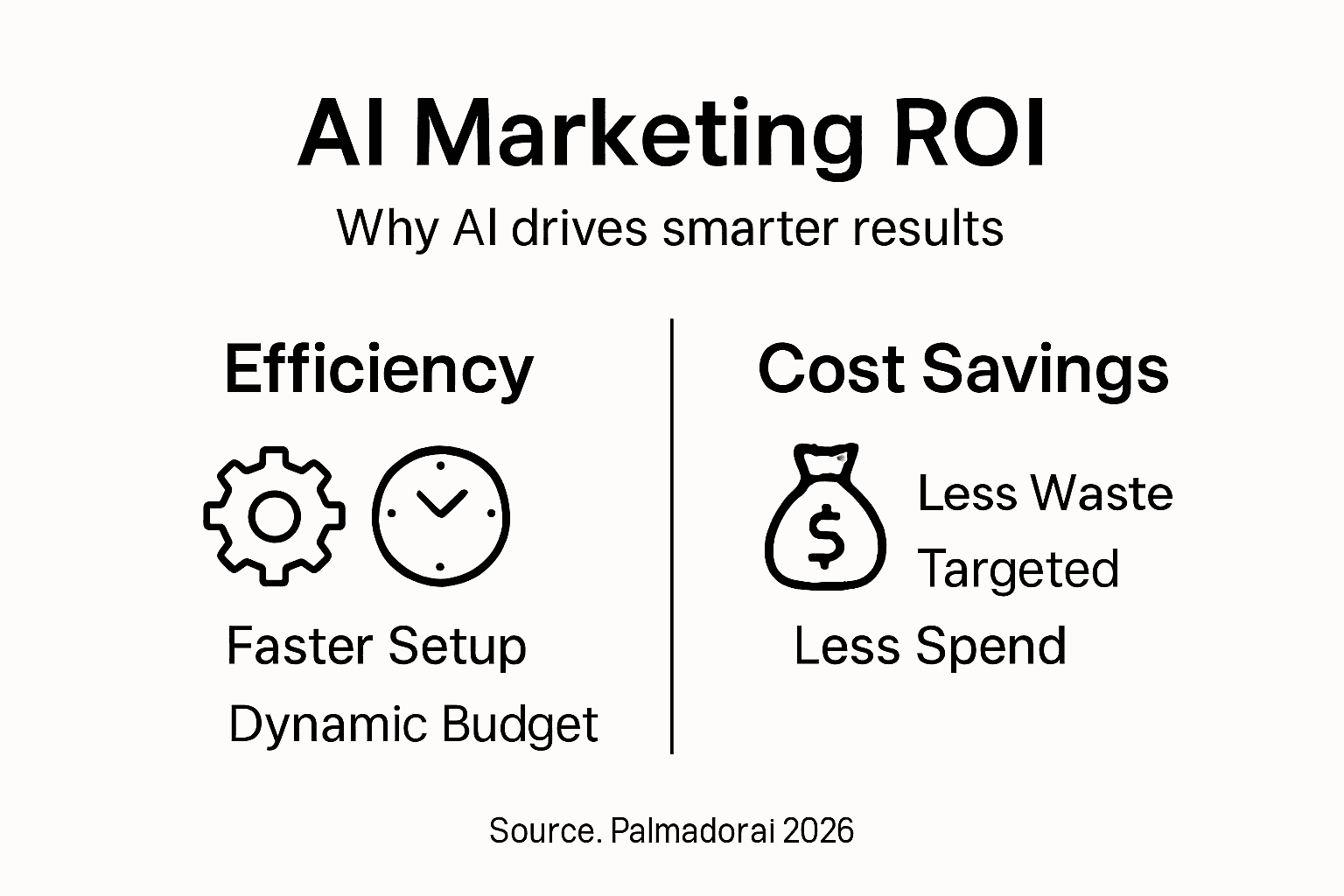
Artificial Intelligence is dramatically transforming marketing economics by delivering unprecedented efficiency and cost optimization across digital advertising strategies. Marketing ROI enhancement technologies are enabling businesses to achieve remarkable performance improvements while simultaneously reducing operational expenses.
Key cost and efficiency advantages of AI-driven marketing include:
- Automated task processing
- Precision audience targeting
- Real-time budget optimization
- Rapid performance analysis
- Dynamic campaign adjustments
- Predictive resource allocation
Intelligent automation represents a fundamental shift in marketing economics, allowing companies to streamline complex processes that traditionally required extensive human intervention. These advanced systems can analyze massive datasets, make instantaneous strategic decisions, and continuously optimize marketing performance with minimal manual oversight.
AI transforms marketing from a cost center into a strategic revenue generation engine.
The financial implications of AI adoption are profound. Businesses implementing sophisticated AI marketing tools can expect significant improvements in key performance metrics. Machine learning algorithms enable more intelligent spending, reducing customer acquisition costs while simultaneously increasing conversion rates and overall marketing effectiveness.
Pro tip: Start with small-scale AI implementation, measure incremental gains, and progressively expand your technological capabilities to maximize return on investment.
Risks, Challenges, and Best Practices
Artificial Intelligence in marketing presents a complex landscape of transformative potential and significant ethical considerations. AI marketing ethics framework requires businesses to navigate intricate challenges while maintaining consumer trust and regulatory compliance.
Key risks and challenges in AI marketing include:
- Algorithmic bias and discrimination
- Data privacy and consent violations
- Transparency and explainability limitations
- Potential manipulation of consumer behaviors
- Regulatory compliance complexities
- Unintended algorithmic decision-making
Ethical AI governance demands a proactive approach to mitigating potential negative consequences. Marketers must implement robust safeguards that protect consumer rights while leveraging technological capabilities, creating a delicate balance between innovation and responsible practice.
Responsible AI implementation is not optional - it's a fundamental requirement for sustainable digital marketing.
Successful AI integration requires comprehensive strategies addressing potential pitfalls. Algorithmic transparency becomes critical, ensuring that AI systems can be audited, understood, and adjusted to prevent unintended discriminatory or manipulative outcomes. Companies must invest in continuous training, ethical review processes, and adaptive governance mechanisms.
Pro tip: Develop a cross-functional AI ethics committee that includes legal, technical, and marketing professionals to continuously assess and mitigate potential risks in your AI marketing strategies.
Unlock Smarter Marketing ROI with AI-Driven Digital Ads
The article highlights the challenge of maximizing marketing efficiency and achieving a higher return on investment through AI-powered tools like predictive behavior modeling, hyper-personalization, and real-time optimization. Businesses often struggle with complex data analysis, manual campaign adjustments, and maintaining brand consistency while crafting impactful ads. Palmador.ai solves these pain points by automating the creation of high-performing digital ads that align with your brand identity and proven market trends. This platform helps marketers, SMEs, and agencies save time, reduce costs, and boost ad performance without needing advanced technical skills.
Key benefits include:
- Automated ad design based on trend analysis and winning strategies
- Enhanced personalization that drives engagement and conversions
- Real-time ad optimization for smarter budget allocation
Harness the power of AI-powered marketing today and transform your digital advertising into a revenue engine.
Ready to elevate your marketing effectiveness and see measurable ROI improvements now? Explore how Palmador.ai’s innovative platform simplifies your ad creation process while delivering impactful, personalized campaigns at scale. Start your journey to smarter digital marketing by visiting Palmador.ai and experience the future of AI-driven advertising.
Frequently Asked Questions
What are the key benefits of using AI in marketing?
AI enhances marketing through automated task processing, precision audience targeting, real-time budget optimization, and predictive resource allocation. These advantages lead to significant performance improvements and reduced operational costs.
How does AI improve customer personalization in marketing?
AI creates personalized customer experiences by analyzing behavioral patterns in real-time, allowing for dynamic content customization, intelligent recommendations, and tailored communication strategies that adapt to individual customer preferences.
What challenges should businesses consider when implementing AI in marketing?
Businesses face challenges such as algorithmic bias, data privacy concerns, and the need for transparency in AI decision-making processes. It's essential to implement ethical AI governance to mitigate these risks effectively.
What role does predictive analytics play in AI marketing strategies?
Predictive analytics uses AI to analyze data and forecast future customer behaviors, enhancing targeting strategies and improving conversion rates by enabling proactive engagement with customers before their needs arise.